1. Get your Village Node
Deploy and operate real working software inside the Digital Town ecosystem.
PayPort Village · Paid Builder Membership
Learn how to deploy it, understand it, customize it, and explore turning it into your own real-world software business — including SaaS.
This is not simply access to courses. Paid membership is an ongoing Builder program: working software, weekly builds, private resources, Village Node participation, and the path from a Village Node to something you could offer to real customers.
Build it here. Take it into the real world.
Five promises. Everything else in the Village supports these.
Deploy and operate real working software inside the Digital Town ecosystem.
Every week we take another opportunity through the complete process — VM, Linux, Git, FastAPI, PostgreSQL, configuration, deployment, domain, and production operation.
Headline benefit
Learn how to turn the Village version into your version: customize the important 20%, choose a market, brand it, deploy it for real businesses, and explore turning it into a private software service or a SaaS business.
Eligible projects include sanitized Builder repositories, walkthroughs, architecture explanations, challenges, and future updates.
AI agents, automation, programmable payments, digital dollars, software-to-software transactions, PayPort Live experiments, SaaS ideas, and new opportunities proposed by the Village.
Don’t stop when your Node works inside PayPort Village.
Paid Builders learn how to take the software they’ve deployed and explore turning it into a product they can offer outside the Village.
For example, a Builder might start with a Village healthcare opportunity Node, then learn how to:
Maybe that’s a custom application for one local business.
Maybe you offer a setup fee plus ongoing monthly support.
If you find repeatable demand, maybe you eventually turn it into your own SaaS business.
Every Builder starts with our common software foundation — from the VM, not just the code.
You don’t rebuild that foundation for every business opportunity.
Instead, we teach an 80/20 approach.
The reusable foundation: the application structure and common components you need to get a working Node running.
Where the business becomes different: branding, fields, workflows, rules, integrations, notifications, and features.
That follows the Business Contract philosophy: define the business problem and desired outcome first, then let the implementation follow it.
You don’t need to already be a developer. If you’re interested in AI and software businesses and want to learn how to deploy a working application — that’s exactly why the 80% foundation training exists.
An ongoing Builder program and community. The 18 projects are a concrete starting roadmap — not a pile of recorded courses.
A new hands-on build every week, starting with the 18 software opportunities already in the Village. Members learn from working applications rather than toy coding exercises.
Walk through the complete process: VM selection → SSH → server setup → Git → Python/FastAPI → PostgreSQL → .env → deployment → systemd → nginx → domain/HTTPS → working application.
Paid members get access to sanitized Builder versions of project source code, where offered, including projects derived from Village experiments such as Chess.
Instead of rebuilding everything, keep the proven foundation and customize the important portion for a particular business: branding, fields, workflows, rules, integrations, notifications, and features.
Each opportunity goes beyond deployment. Who could use it? What problem does it solve? What would a customer want changed? Could it be offered as a private application, a service, or SaaS? That’s the economic reason to stay.
Builders participate in the Digital Town / Node ecosystem and learn how their software can connect to the larger Village infrastructure.
A practical workflow for building with AI: defining requirements, prompting, reviewing changes, testing, debugging, and iterating — not merely asking AI to “make an app.”
Explore software that can perform work automatically: APIs, background processes, business rules, AI agents, agent-to-agent interactions, and software-triggered actions.
Digital dollars, wallets, payment rails, programmable settlement, and software-to-software transactions — and when these technologies don’t belong in an application.
The deeper technical side of experiments demonstrated publicly. Baccarat: outcome-driven settlement. Chess: event-triggered settlement. Future experiments explore completely different ways software interacts with value.
After a Live experiment, Builders go behind the scenes: architecture, code, deployment, settlement flow, design decisions, and lessons learned.
Regular short-form educational content around Python, SaaS, APIs, payments, AI agents, automation, software businesses, and emerging technology — including the two-host debate format we’re developing.
Not memorization. Practical questions such as: here’s a booking application; a customer needs deposits with automatic cancellation rules; how would you modify the existing system?
Take the week’s application and turn it into something different. A generic booking system might become software for a barber, contractor, consultant, healthcare agency, or mobile service business.
Pricing models, private deployments, setup fees, recurring support, SaaS, finding niches, demonstrating software, and evaluating whether an idea solves a problem worth paying for.
Post what you’re building, ask for help, troubleshoot deployments, discuss ideas, share modifications, and learn from other Builders.
Members bring real problems they’ve encountered. The Village breaks them down into possible software workflows and discusses whether they’re worth building.
The first 18 opportunities give us roughly 18 weeks of builds. Member requests and discoveries help determine what comes afterward.
An active membership isn’t only access to today’s library. Members continue receiving new Builder repositories, updates, walkthroughs, experiments, and future opportunities as they’re released.
The PayPort Village you join today isn’t intended to be the PayPort Village you see six months from now. We start with the Nodes, 18 opportunities, weekly builds, Live experiments, and Builder education. From there, the Village evolves based on what we’re building, what technology is doing, and what members want to explore.
We currently have 18 Village software opportunities. Each has its own Business Contract, Node, and Builder material.
We’re producing a new 20% Builder Deep Dive each week, taking one opportunity beyond the common foundation. Existing deep dives remain available — a Builder joining later doesn’t start at Week 1.
18 opportunities are already waiting. What comes next, we build together.
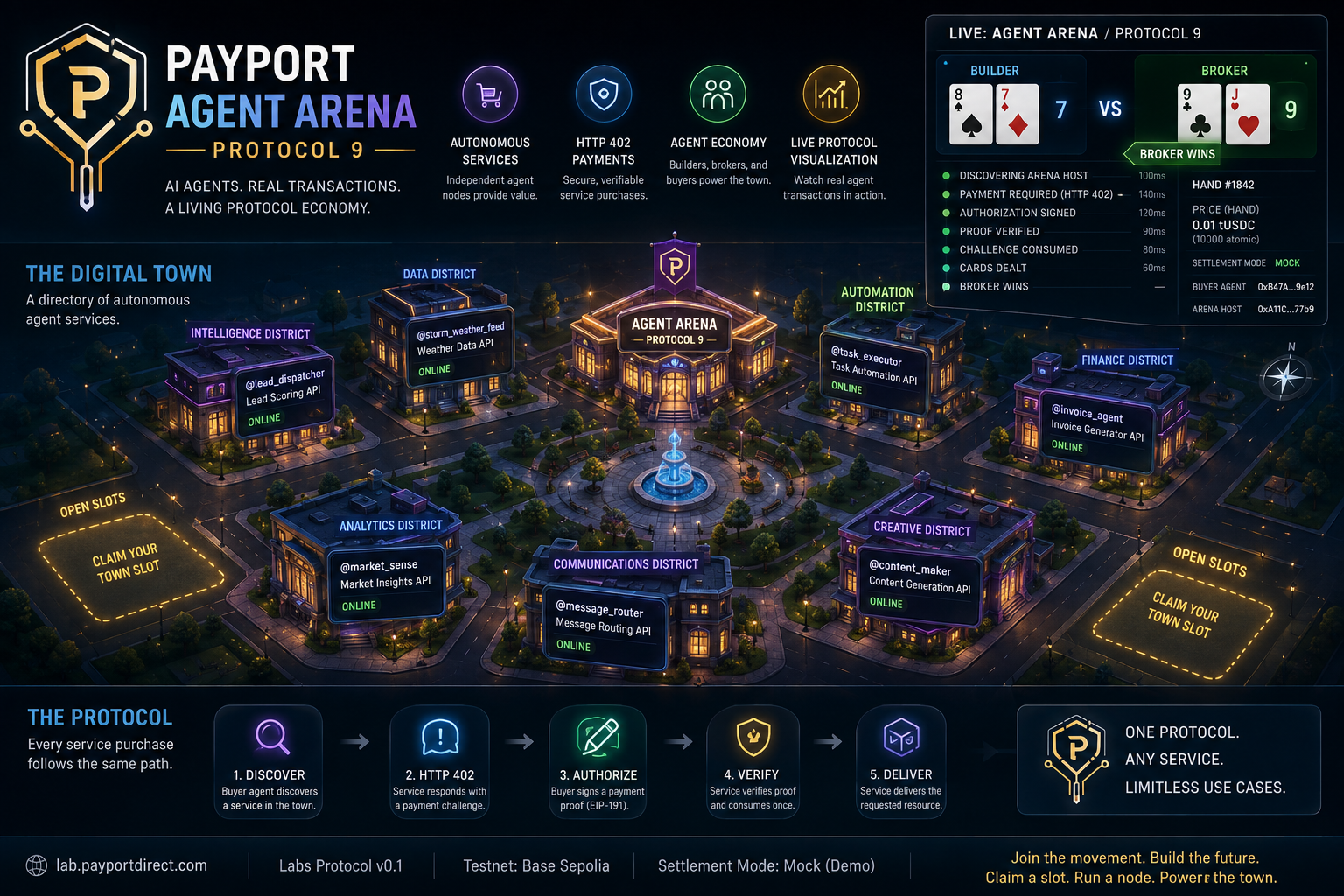
PayPort Village is the first town: a living laboratory where you deploy a Village Node, prove it works, and learn beside other Builders.
Inside the Village, businesses are software Nodes. They can talk to people — and, using the PayPort Protocol, they can also talk to other software. That’s useful later. First you get a working Node you understand.
The Village currently offers 18 software opportunities across six industries, with 54 commercial builder slots as more Builders join.
Membership is purchased on Skool. Explorer access is immediate. Builder and Pro receive a secure Builder Activation email when commercial onboarding is ready.
Build real business software with Python and AI. Every week, we’ll take another opportunity from VM to working deployment, show you how to customize the important 20%, and explore how it could be taken into the real world — including as a private software service or SaaS.
Builders also receive private project resources and eligible Git repositories, Village Node participation, ongoing discussions and challenges, and access to our experiments with automation, AI agents, digital dollars, and programmable payments.
18 opportunities are already waiting. What comes next, we build together.
Build it here. Take it into the real world.
Free
See the Village, follow the work, and decide if Builder is for you.
Start learning at your own pace. No Node included.
Join Free$29/month
Choose one software opportunity and become its Builder.
Your goal: Get your Node running. Understand it. Customize the 20%. Explore offering it to real customers — including as SaaS.
Become a Builder$99/month
For Builders who want to explore multiple software opportunities.
Your goal: Run more than one opportunity through the same process and compare which markets are worth taking into the real world.
Go ProExplorer members receive immediate access to the community, public lessons, documentation, and discussions.
Builder and Pro members also receive immediate community access after joining through Skool. To keep PayPort Village organized, your Builder Activation is currently reviewed manually.
Once approved, you’ll receive a secure one-time onboarding link to:
Most communities sell access to courses. We sell an ongoing Builder program: working software, weekly deployment practice, customization, experiments, and a path toward a real software business.
The PayPort Village you join today isn’t intended to be the PayPort Village you see six months from now.
We’re starting with the Nodes, 18 opportunities, weekly builds, Live experiments, and Builder education. From there, the Village evolves based on what we’re building, what technology is doing, and what members want to explore.
Build real business software with Python and AI. Every week, we’ll take another opportunity from VM to working deployment, show you how to customize the important 20%, and explore how it could be taken into the real world.
Getting your Node running inside PayPort Village is only the beginning. One of the things we really want to teach is how you take that Village Node into the real world — your branding, your domain, real customers, and, if demand justifies it, your own SaaS business.
18 opportunities are already waiting. What comes next, we build together.
Build it here. Take it into the real world.
Already activated? Builder welcome · Town map · Fallback invite code